



















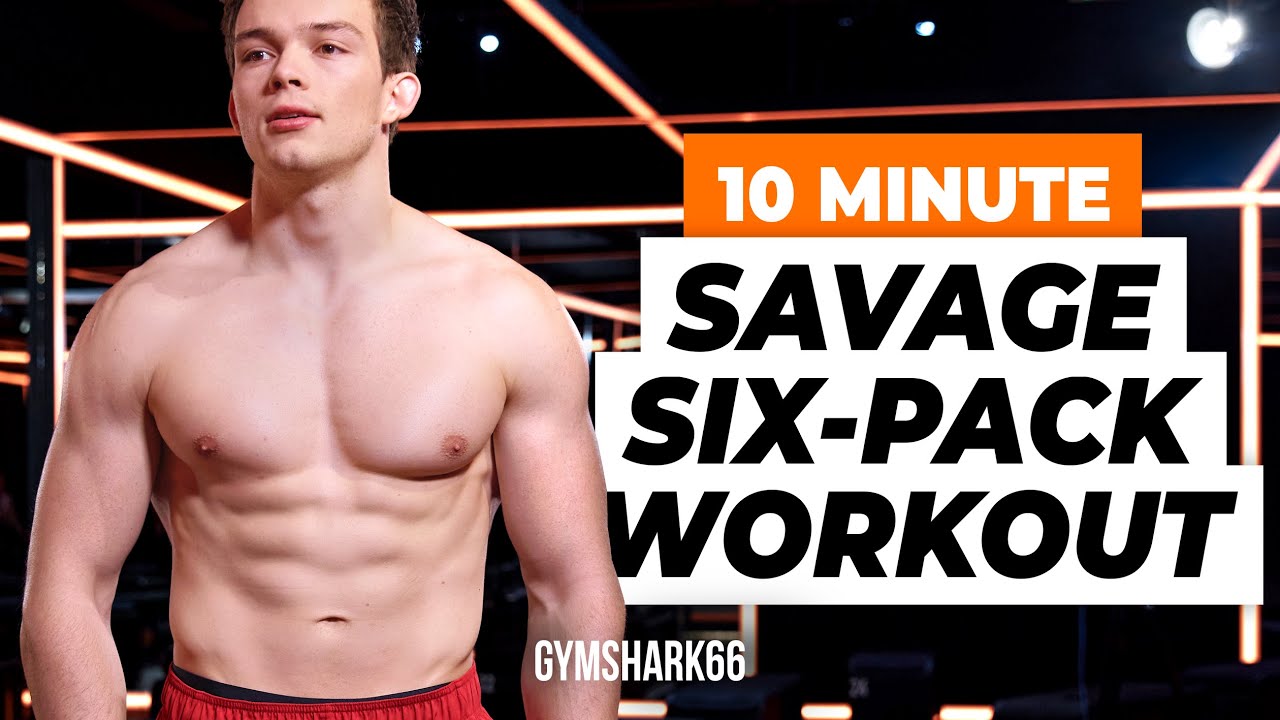
A chiseled core with well-defined ab muscles is the pinnacle of an athletic physique.
But there’s more to abs than meets the eye – these small, powerful muscles are there to help during almost all exercises, whether you’re looking to pull a heavier deadlift, knock time off your 5K, or perfect your posture.
But with endless options of ab routines available at our fingertips, how do you know what the best core exercises really are? Luckily, we’ve done the work for you–so say goodbye to endless scrolling, and hello to the ultimate ab workout.
We’re talking about focused core exercises, along with proper nutrition, that will guarantee you look built in a muscle-fit shirt or toned in a crop top (and provide that satisfying ache in your abdominals every time you laugh, cough, or twist).
Get ready for the best core exercises, expert advice on training frequency, and a note on nutrition for fat loss.
The Best Ab Exercises
The best ab workouts train the core using different angles, tempo, and rep ranges to build a balanced midline framed by defined obliques (the muscles along the sides of your core responsible for stabilizing and rotating the torso).
This means an effective abdominal workout contains much more than just crunches (which only train your abs using the back and forward flexion of the spine). It challenges the core using varying planes of motion, core engagement, and training styles.
First, we’ll start with bodyweight ab exercises that require no equipment—perfect for training your core at home. Then, we’ll move on to weighted core exercises, which add resistance to increase the challenge and allow you to progressively overload as you get stronger.
Bodyweight Ab Exercises
1. Bicycle Crunches
A variation of the classic ab crunch, bicycle crunches are a rotational ab exercise that involves spinal rotation to engage your obliques and the hard-to-reach transverse abdominis deep in the core.
The American Council on Exercise (ACE) ranks bicycle crunches as the best ab exercise [1]. With no equipment required, they're well suited to beginners, those working out from home, or a fiery finisher post-workout.
How To Do Bicycle Crunches:
Lie on your back with your knees bent at a 90-degree angle, feet flat on the floor, lower back in contact with the mat.
Raise your hands, placing them gently on the side of your head behind your ears. Raise your feet off the ground, bringing your knees to a 90-degree angle.
Take a deep breath in, brace your core, and then, as you exhale, bring one knee up towards your chest, extending the other leg out in front of you.
As your knee comes in, rotate your torso, twisting so your opposite elbow touches the bent knee.
Pause, then twist to the other side, extending the bent leg and bringing the extended leg in to touch the opposite elbow. Repeat this motion for 20 to 30 reps for 3 sets.
2. Bird Dog Exercise
Despite the strange name, bird dogs are an effective core exercise that targets the rectus abdominis and the obliques. They build lower back function and can even reduce lower back pain by engaging the core and back muscles simultaneously [2,3]. If you struggle with back pain during core exercises or your big lifts, bird dogs can be a great way to ease this.
How To Do Bird Dogs:
Kneel on all fours on a mat, hands directly below shoulders, knees stacked below hips.
Bracing your abs, extend opposite arm and legs straight out in front and behind to form a straight line. Keep your hips square and back straight.
Hold for 2 seconds, then bring the arm and leg back in, driving your elbow towards your knee.
Pause, then begin the second rep, extending the legs and arms back out in front.
Complete 10 reps on one side, then switch sides to complete the same steps.
TIP: Try to minimize motion in your hips, keeping them square to the ground, especially as you transition from one side to the other.
You can also alternate sides, returning the knee and hand to the mat after each rep, before extending out the opposite arm and leg. This will feel slightly easier.
3. Leg Raises
A staple in Marissa Mcnamaraa’s ab routine, leg raises are one of the best lower ab exercises. They help increase strength and muscular control throughout the core, with particular emphasis on the rectus abdominis. They also target the hip flexors, strengthening them to improve squats, running, and jumping.
Leg raises can be performed flat on the floor, on an incline bench, or hanging from a bar, depending on your strength and experience – the latter variation being the most advanced!
A standard tempo for leg raises is 3-1-2-0, representing the eccentric (lowering) phase, pause at bottom, concentric (lifting) phase, pause at top. Increasing the eccentric (lowering) phase is one of the most effective ways to make lying leg raises more challenging.
How To Do Lying Leg Raises:
Lie flat on your back with your legs extended and arms by your sides or under your glutes for support.
Brace your core and press your lower back into the floor to avoid arching.
Lift your legs up together until they’re perpendicular to the floor, keeping them straight.
Lower your legs slowly toward the floor with control, stopping just before your heels touch down.
Repeat the movement, maintaining core tension and avoiding momentum throughout.
TIP: If you find your lower back creeping off the floor, consciously think about pulling your belly button down towards your spine. You can also try placing your hands underneath your lower back as you do the exercise to support your pelvis. Still an issue? Don’t bring your legs as low: stop just before the point where your lower back loses contact with the floor.
4. Side Plank
Side planks are a highly effective isometric ab exercise that targets the obliques, transverse abdominis (deep core stabilizers), glutes, and shoulder muscles.
Unlike traditional crunches that focus on flexion, side planks emphasize anti-lateral flexion—training your core to resist side bending and maintain spinal alignment. This makes them excellent for building core endurance, improving posture, and enhancing overall stability, improving form and reducing injury risk during dynamic activities and compound lifts.
How To Do A Side Plank:
Lie on your side with your legs extended and feet stacked.
Position your forearm on the ground directly under your shoulder.
Engage your core and lift your hips off the floor, forming a straight line from head to feet.
Hold this position (aiming for 15, 30 or even 60 seconds), keeping your body stable and hips elevated.
Lower your hips back down with control and repeat on the other side.
TIP: Make this movement harder by adding a hip dip, lowering your hips towards the ground when in the side plank, and then moving them back up towards the ceiling. Aim for 10 reps on one side, before switching to the other.
Weighted Core Exercises
5. Russian Twists
Russian twists are a dynamic core exercise that primarily target the obliques, along with the rectus abdominis and transverse abdominis. By performing controlled rotational movements while holding a seated position with your feet off the ground, Russian twists challenge both your core strength and balance. The twisting motion helps your core build and control the force needed to turn your body, which is important for sports and activities that involve lots of twisting and turning, such as tennis, golf, baseball, and swimming.
While these can be performed using just bodyweight, adding resistance such as a medicine ball, kettlebell or sandbag will increase the difficulty, making your core work that little bit harder!
How To Do Russian Twists:
Sit on the floor with your knees bent and feet flat or lifted slightly off the ground.
Lean back slightly while keeping your back straight and core engaged.
Clasp your hands together or hold a weight in front of your chest.
Twist your torso to one side, bringing your hands or weight beside your hip.
Twist back to the other side in a controlled motion, repeating for the desired reps.
TIP: To help balance, cross your feet and try to hold your legs in the center of your body, avoiding swinging when rotating your torso. Don’t rush the movement: Keep the reps slow and controlled.
To make this exercise harder, take your legs straight out in front of you, rather than keeping them bent – you’ll have to work your core that little bit harder to stabilize yourself and you’ll definitely feel the burn!
6. Cable Woodchopper
Gaining its name from the motion of chopping down a tree, this is another rotational core exercise that simultaneously challenges targeting the obliques, rectus abdominis, and deep core muscles, training your core to generate and control torque, improving your ability to twist and rotate with power and precision. It also engages your hips, shoulders, and back, making it a functional movement that translates well to sports and everyday activities involving rotational forces.
Don’t worry, no trees will be harmed in the process – all you need is a cable and a handle attachment.
How To Do The Cable Woodchopper:
Attach the handle grip attachment to the cable, and set the height to somewhere between chest or shoulder height. Adjust the weight to a weight you can perform 10-12 reps on each side with.
Clasp the handle in both hands and take a couple of steps away from the tower, keeping your arms outstretched. Stand side on to the tower, feet shoulder-width apart, knees slightly bent.
Pull the handle, rotating your torso 180 degrees, keeping your arms fully extended throughout. Keep a neutral spine, focusing your gaze on your hands throughout.
Hold for one to two seconds before rotating back to the starting position.
Repeat for 10 to 12 reps, then switch sides by turning around and facing the other way.
TIP: When performing cable woodchoppers, focus on rotating only the upper half of your body, twisting the torso away from the cable, keeping your arms straight, and facing your thighs forward.
Cable Woodchopper Variations: You can also perform high-to-low and low-to-high cable chops by adjusting the height of the cable on the tower and moving the cable at a 45-degree angle, instead of side-to-side. These will work your obliques at a slightly different angle.
7. Cable Crunch
If there’s one exercise you shouldn’t skip in your next ab workout, it’s the kneeling cable crunch. A favorite in many Gymshark athletes’ ab routines, including Marissa Mcnamara and Dylan Shannon, this weighted ab exercise focuses on strengthening the rectus abdominis—the main “six-pack” muscle—while also engaging the obliques and deeper core stabilizers. Performed kneeling or standing, the cable crunch involves pulling the rope down by crunching your torso forward, emphasizing controlled spinal flexion.
The rope attachment provides a comfortable grip and encourages a natural range of motion, allowing you to focus on contracting your abs without straining your neck or shoulders. Using a cable machine with a rope allows for adjustable resistance, making it easy to progressively overload your core muscles.
How To Do Cable Crunches:
Set the cable machine up to the top of the tower and attach the rope attachment.
Take hold of the end of the ropes in both hands, taking a couple of steps away from the tower to move the weights off the stack whilst turning to face away from it. Kneel down, placing both knees on the floor directly below shoulders.
Hold the rope handles above the top of your head in an overhand grip, thumbs facing the ceiling.
Begin the crunch by bracing your core and taking a breath in. Hinge from your hips, breathing out as you contract for abs and curl your torso towards the ground. The rope should remain above your head at all times, chin tucked (imagine you are trying to hold an egg under your chin!). Aim to lower until your elbows are close to your legs, squeezing your abs the whole time.
Pause, then slowly extend your torso to come back to the starting position.
TIP: If you find cable crunches too difficult, instead of reducing the weight, try turning around and performing the crunches facing the tower. Facing this way, the resistance path of the cable won’t pull you backward, making it easier to ‘crunch’.
For a harder variation, try a standing cable crunch. You’ll have to work a lot harder to stabilize your entire body throughout the movement, upping the core engagement required to perform the movement.
8. Med Ball V Ups
Med ball v sit ups (or jack knives) are a challenging core burner that will fire up both your rectus abdominis and your transverse abdominis, along with the hip flexors, adductors, and quads.
Med ball V-ups are an advanced core exercise that combines the traditional V-up movement with the added resistance of a medicine ball. This exercise targets the rectus abdominis, hip flexors, and obliques, challenging both core strength and coordination.
They aren’t easy: By holding the med ball overhead and bringing it toward your feet as you lift your torso and legs simultaneously, you increase the intensity and range of motion compared to bodyweight V-ups. Starting every rep from a hollow body position will test your core and require some serious strength to drive the med ball up toward your toes!
How To Do Med Ball V Ups:
Choose a moderate-weight medicine ball and place it behind the top of your mat. Lie flat on your back with your legs extended out, reaching your arms overhead to take hold of the med ball.
Point your toes, squeeze your quads together, and engage your core. Taking a deep breath in, lift your feet slightly off the floor.
Begin the rep by simultaneously moving your legs and arms (still holding the medicine ball) towards each other to create a ‘V’ shape with your body. Aim to touch the medicine ball to your toes. Arms and legs should remain straight throughout.
Slowly lower your arms and legs back down to the floor, keeping them straight and exhaling as you do so. Touch the med ball back on the floor behind you after each rep. To make the exercise harder, try not to let your heels touch the floor, stopping when they are about 10 cm away, before beginning the next rep.
Repeat for 10-15 reps.
Tip: If you struggle to straighten your legs, bend your knees and aim to reach your knees, rather than your toes. In the meantime, work on some hamstring stretches to improve flexibility so you can work your way up to doing toe-touch crunches with straight legs.
If you find these too challenging, either go for a lighter med ball or ditch the med ball entirely and do the v ups using just you’re bodyweight – trust us when we say this variation is still very challenging!
The Only Ab Exercises You Need
Building a strong core takes diligence, discipline, and hard work – and it won’t happen overnight, but we’ve given you the tools to work intelligently with your training to hit every square inch of your midsection.
For ultimate ab definition, perform 3 of the core exercises above for 10-15 reps, for three rounds, three times a week. Make sure you include a mixture of flexion exercises (like crunches) with rotational ones (such as Russian Twists). Your lifts will soon start to feel stronger, your body more stable and you’ll feel confident taking off your shirt mid-sweat session or just wearing a sports bra to the gym – it’s a win-win if you ask us.
FAQs
What Are Abs?
The abs (part of the core) are located around your midsection, made up of four key groups:
Rectus Abdominis (The ‘six-pack muscles’; located in the middle of the abdomen, these muscles help you flex forward)
Transversus Abdominis (The deepest muscle of the abs that wraps around the waist to support the spine)
External Obliques (The outermost ab muscle that runs from the ribs to the pelvis, helping the body rotate and bend from side to side)
Internal Obliques (Sit underneath the external obliques, also assisting with rotation of the trunk and bending)
Each is a separate muscle, but together they allow the trunk to rotate and flex, stabilizing the body through various movements. To develop a crisp six-pack, you’ll need to dedicate time to training and refining each of these four muscle groups, and whilst most ab exercises don’t target a singular area, most do place more focus on one muscle group.
How Many Ab Exercises Should I Do?
As a rule of thumb, choosing 3 core strengthening exercises from above, and performing 10-15 reps for 3 sets is a good benchmark to aim for. You may find it easier to put the clock on and perform a Tabata-style workout (20 seconds on, 10 seconds off, or if you’re feeling up to a challenge, 40 seconds on, 20 seconds off) for three rounds.
To build a well-rounded core workout, you should ensure you are choosing a variety of ab exercises, for example, crunches, Russian twists, and v-ups, balancing flexion exercises with rotational ones to cover all of the movement patterns. Try and vary the exercises you do each day to continuously challenge your body and avoid reaching a plateau.
How Do I Get Abs?
First off, let's be clear, you have abs. Whether they mimic a cheese-greater or not, the fact is you already have abs. Whether they show or not depends on the amount of body fat you hold. Ultimately, you can do all the ab exercises in the world to build a strong core, but if it’s covered by belly fat, you aren’t going to see it.
According to the American Council on Exercise (ACE), you’ll need to lower your body fat to about 14 to 20 percent for women and 6 to 13 percent for men if you want your abs to be seen [4]. Unfortunately, you also can’t spot reduce your body fat, meaning you have no control over where your body stores extra calories, and where it takes that energy from. But there are a couple of methods you can use to build the size of your abs whilst reducing belly fat:
Reduce your calories: To lose fat you need to be a calorie deficit. That means burning more calories than you’re taking in. Research has found that intermittent fasting can be a beneficial way to achieve weight loss (it doesn’t suit everyone, but may be worth a look at).
Increase protein intake: When losing weight, you want to try and lose fat, whilst maintaining as much lean muscle as possible. Making sure you are eating enough protein can help this, with studies finding that those who ate higher-than-average amounts of protein (1.2 to 1.5 grams per 2.2 pounds of body weight) whilst trying to lose weight preserved more lean muscle mass and improved body composition compared to those who ate average amounts of protein (0.8 grams per 2.2 pounds) [5].
Do strength training and cardio: Many people think cardio is the best way to lose weight. Studies have proven that combining 30 minutes of cardio with 30 minutes of strength training three times a week leads to greater fat loss than cardio alone [6].
Don’t neglect your ab workouts: The more you train your abs, the more the muscles will grow. Adding in 1-3 focused ab workouts per week alongside your existing routine will help you strengthen and shape your abs.
How Long Does It Take To Get Abs?
The golden question, which doesn’t have a straightforward answer… how long it takes you to get abs is going to depend on your current body weight, genetics, nutrition, and exercise habits. If you go to the gym, you likely already have abs (without a strong core you would struggle with many compound exercises), but if you can’t see the six-pack peeping through already, it’s likely concealed by a layer of fat.
To get them showing through, you need to be training them (to increase the size of the muscle) and losing fat – sounds easy? Don’t be fooled: Getting visible abs takes hard work and dedication (especially for women who naturally hold more fat around their abdominal area). We can’t answer how long it will take, but ultimately you get out what you put in!
Realistically, Can I Get A Six-Pack?
A six-pack may be the ultimate show of fitness, but unfortunately, some of us can do all the ab exercises in the world and still not get the chiseled stomach we dream of. Why? Because everyone’s abs are genetically different, meaning some people are born with the ability to build a six-pack (or a four or eight-pack), and some of us aren’t.
Abs are created by bands of horizontal connective tissue. The number of bands you have will alter how many ‘rows’ of abs you can build. For some that’s a two or four-pack; for a few, it’s an eight-pack or more; It’s not something you can change – it’s part of your genetic makeup. You can still create a strong-looking core, so don’t get too caught up in striving for a six-pack.
Why Are My Abs Uneven?
Again, genetics plays a big part in the appearance of your abs! Whilst some people are born with perfectly caved and stacked abs, others may have an uneven and asymmetric core. It’s not uncommon to have staggered abs, where the abs on both sides are the same size, but don’t line up, creating an uneven effect. It’s all down to genes, and unfortunately, there’s no secret ab exercises we can give you to build your abs in a different shape.
How Often Should I Do Ab Workouts?
Studies have proven that more volume leads to more muscle gains, so technically the more you train your abs, the better (at least if washboard abs are your goal) – but remember that your abs get involved through a whole range of movements, not just specific ab exercises as listed in this article [7]. Take compound movements for example; A strong core is essential to help you lift the load and keep a stable body position. Whilst you might think you aren’t working your core, you are, so it’s important to consider this!
That being said if you are chasing a six-pack, then adding specific core workouts alongside your regular training would be a good way to help you get there. We suggest adding one to three focused ab workouts alongside your existing compound strength training at the end of your workout. But don’t forget to rest too: Try to program your ab workouts on every other day, rather than daily – Trying to laugh with ab DOMS isn’t fun, so give your body time to rest and recover!
Why Do Ab Exercises Hurt My Back?
Ab exercises shouldn’t hurt your back, but for some people, back pain when core training isn’t uncommon. Pain during ab workouts could indicate a weak lower back that simply isn’t strong enough to support you during core exercises. Or, it could point to weaknesses elsewhere in the core, leading your back to overcompensate during the movement. Another reason could be that your form is off: any small movement into an incorrect position could irritate the spine.
So what can you do? Firstly, if you experience back pain, stop the movement immediately. Check your form, and if the pain persists, avoid that movement and swap it for something else.
Exercises such as bird dogs, dead bugs, and glute bridges are a great way to strengthen your core and build lower back function without putting strain on it. Working through these exercises will decrease injury potential and can be a good way to build up core and lower back strength to move onto more advanced core exercises such as leg raises and med ball v ups, at a later point.
What Are The Best Core Exercises For Women?
Fundamentally, core training principles are similar for men and women—both need strong, stable, and functional core muscles to support movement, protect the spine, and enhance performance. Both also often strive for a toned midsection (although a ‘six-pack’ may be more traditionally sought after by men).
However, the biological difference between core training for men and women is that women typically have a wider pelvis and a different lumbar curve (lordosis) than men, which can influence how they load and stabilize their core. Because of this, women may benefit from a greater emphasis on pelvic floor and deep core stabilizers (like the transverse abdominis) to support posture and pelvic health, particularly during or after pregnancy. Exercises that improve pelvic floor health include bird dogs, dead bugs, and glute bridges.
What Are The Best Core Workouts For Men?
The best ab exercises for men are fundamentally the same as the best core exercises for women–whether you’re chasing a toned stomach, a full six-pack, or simply a strong core to provide better stabilization. It’s best to train the abs from all angles–anti-extension, anti-rotation, flexion, and rotation, in order to get the most out of your ab workout.
The best core workout typically consists of 3 to 5 exercises, performed in 2 to 4 sets of 10–15 reps each (or 30–45 seconds if timed), and usually done at the end of your main workout.
References:
Acefitness.org. (2023). American Council on Exercise (ACE)-sponsored Study Reveals Best and Worst Abdominal Exercises.
Dafkou, K., Kellis, E., Ellinoudis, A. and Sahinis, C. (2021). Lumbar Multifidus Muscle Thickness During Graded Quadruped and Prone Exercises. International journal of exercise science, [online] 14(7), pp.101–112. Available at: https://www.ncbi.nlm.nih.gov/pmc/articles/PMC8136566/.
Suh, J.H., Kim, H., Jung, G.P., Ko, J.Y. and Ryu, J.S. (2019). The effect of lumbar stabilization and walking exercises on chronic low back pain. Medicine, [online] 98(26), p.e16173. doi:https://doi.org/10.1097/md.0000000000016173.
Nwosu, Z. (2023). Demystifying Body Fat Percentages: A Healthy Range Explained (Medriva). [online] www.acefitness.org. Available at: https://www.acefitness.org/about-ace/press-room/in-the-news/8540/demystifying-body-fat-percentages-a-healthy-range-explained-medriva/.
Kim, J.E., O’Connor, L.E., Sands, L.P., Slebodnik, M.B. and Campbell, W.W. (2016). Effects of dietary protein intake on body composition changes after weight loss in older adults: a systematic review and meta-analysis. Nutrition Reviews, 74(3), pp.210–224. doi:https://doi.org/10.1093/nutrit/nuv065.
De Mello, M.T., de Piano, A., Carnier, J., Sanches, P. de L., Corrêa, F.A., Tock, L., Ernandes, R.M.Y., Tufik, S. and Dâmaso, A.R. (2010). Long-Term Effects of Aerobic Plus Resistance Training on the Metabolic Syndrome and Adiponectinemia in Obese Adolescents. The Journal of Clinical Hypertension, 13(5), pp.343–350. doi:https://doi.org/10.1111/j.1751-7176.2010.00388.x.
Schoenfeld, B.J., Contreras, B., Krieger, J., Grgic, J., Delcastillo, K., Belliard, R. and Alto, A. (2018). Resistance Training Volume Enhances Muscle Hypertrophy. Medicine & Science in Sports & Exercise, [online] 51(1), p.1. doi:https://doi.org/10.1249/mss.0000000000001764.
