
















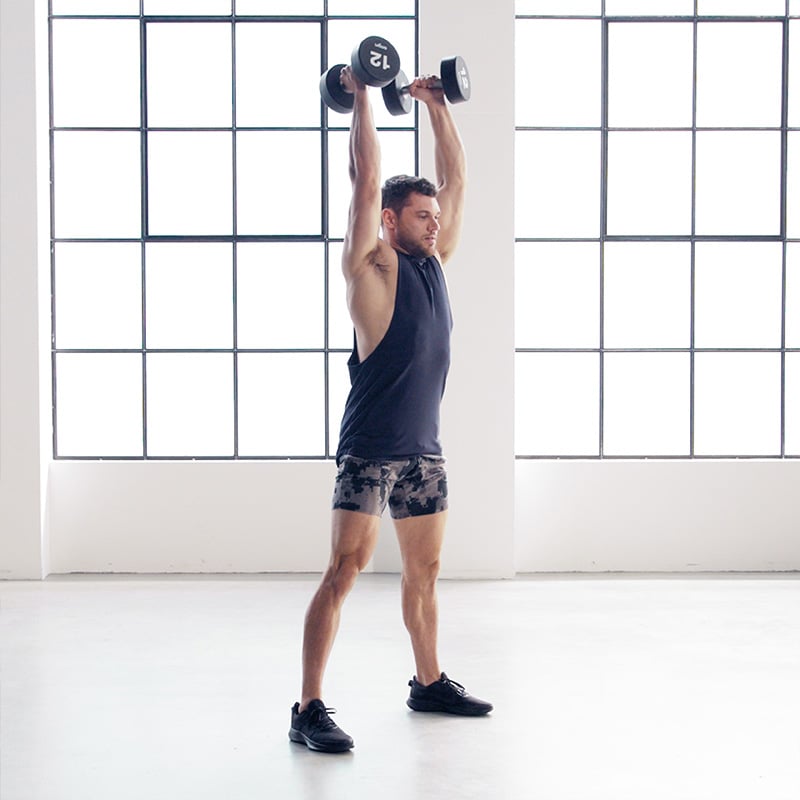

If there’s one exercise that really reflects its name, it’s the Devil Press.
An unforgiving blend of burpees and overhead power, the devils press lights up your whole body, testing your strength, lungs, and mental grit.
Using a single (or double) dumbbell(s), its minimalist approach combined with its effectiveness is probably why it holds a firm place in many functional fitness classes. The ultimate symbol of the ‘no pain, no gain’ mentality—each rep earned with sweat and rewarded with serious physical gains.
Whether you're familiar with this monster of an exercise already, or you’re totally new to the challenge, we’ll guide you through mastering the devil press—nailing your form, dialling in your technique, and picking up the pace
So next time you see ‘Devil Press’ written on the whiteboard, you’ll face it with confidence instead of dread. 😈
What Is A Devil Press?
A devil press is a functional, full-body compound movement that combines a burpee with a dumbbell snatch (where you lift a dumbbell from the floor (or just below the knee) straight overhead in one continuous motion).
The devil’s press is generally completed with two dumbbells; however, a single-arm devil press is also a great variation of this exercise.
It’s commonly used within functional training and class-based workouts thanks to its effectiveness in targeting the whole body to develop strength and endurance.
How To Do The Devil Press
As a word of warning, the devil press is no easy exercise – but it’s a great one to master and prepare you for many other exercises, including the barbell snatch and push press.
The devil press is performed using a single or pair of dumbbells. If you’re new to the db devil press, it’s a good idea to start with learning the fundamental exercises first.
These include:
Burpee: This is the first part of the devil press. It’s a full-body movement where you squat to the floor, jump your feet back into a plank, then jump them in and finish with an explosive jump overhead — all in one fluid motion.
Dumbbell Shoulder Press: This will help you practice pressing the dumbbell overhead, which is important in the second portion of the devil press. Place the dumbbell on your shoulder, dip your knees slightly, then drive the dumbbell powerfully overhead, locking out your arm at the top before bringing it back down to your shoulder.
Dumbbell Snatch: This exercise teaches how to move a dumbbell explosively from the floor to overhead in one fluid motion, which is exactly how the devil press finishes. It develops hip drive, power, and coordination. Start with the dumbbell on the floor between your feet, hinge at the hips to grip it, then drive through your legs and hips to pull the weight powerfully overhead in one motion, finishing with your arm locked out. Return the dumbbell to the floor under control and repeat.
Once you are confident with all three exercises, you are ready to learn the devil press!
So, How Do You Do The Devil Press?
These are the key steps to learning the devil press exercise:
Set-Up: Stand with your feet shoulder‑width apart, your pair of dumbbells placed just outside your feet, parallel to each other, and handles facing front to back (longways). They should be slightly in front of your toes (2-4 inches / 5-10 cm).
The Burpee: Hinge at the hips, bend your knees, and place your hands around the dumbbells, knuckles down. Jump or step your feet back into a high plank. Lower your chest to the ground so it is in line with your dumbbells and wrist, keeping hands gripping the dumbbells (some people let go and place palms flat between reps for wrist relief). (Note: your chest must touch the ground.)
Jump In: Explosively jump (or step) your feet back towards your hands, landing in a strong hinge position (hips back, back flat, chest up). Grip the dumbbells firmly, ready to swing them.
The Snatch: Using your hips, swing the dumbbells back between your legs (like a
kettlebell swing), then drive your hips forward. Use that momentum to swing or snatch both dumbbells overhead in one motion, finishing with arms locked out and biceps by your ears. (Note: You must reach full extension at the top of the snatch, with arms locked out overhead.)
Reset and repeat: Lower the dumbbells with control back to the floor between your feet. Maintain a flat back and soft knees, ready to drop into the next burpee.
How To Do A Single-Arm Devil Press
For the single arm devil press, the exercise fundamentals remain the same as those outlined in the regular devil press exercise. The key difference is using one dumbbell, which can either stay in the same arm for multiple reps or alternate arms for each rep.
A 2024 study by Duan et al. on college basketball players found that unilateral training was better at improving change-of-direction speed, non-dominant leg explosive power, and dynamic balance — all of which are vital in sports and everyday movement [1]. Meanwhile, bilateral training led to greater gains in bilateral explosive power and maximal strength.
What does this mean for your workout? Using a single-arm devil press could challenge your core stability, balance, and coordination more intensely, making it great for functional athleticism and evening out left-right imbalances. On the other hand, the double-arm version better targets whole-body power and strength, making it ideal for building muscle and maximal output.
Effective Transitions For Alternating Dumbbell Devils Press:
Switch hands on the floor: Snatch the dumbbell overhead using your right hand. As you bring your arm down, place the dumbbell on the inside of your left foot (opposite to the hand in which you are holding the dumbbell). Swap hands, placing your left hand around the dumbbell as you jump down, and perform your next rep using your left arm.
Switch hands mid-air: After you snatch the dumbbell overhead with your right hand, bring it back down. As the dumbbell reaches around chest height, catch the dumbbell in your left hand.
The first of these transitions is usually more efficient and safer. The second technique relies on fast, precise grip transfer and timing. It should only be done if you are confident with a DB Devil's press and should always be practiced with a lighter dumbbell first to master the technique.
Devil Press Form Q&A
👉 What Dumbbell Weight Should I Use When Performing The Devil Press?
Choosing the right dumbbell weight for the Devil Press depends on your current strength, experience, and fitness goals.
If you’re new to the movement, start with light dumbbell(s) e.g. 5–15 lbs (2–7 kg).
Once you’re comfortable, gradually increase the weight to challenge your muscles and cardiovascular system, making sure to always prioritize form over weight. Intermediate lifters often use dumbbells between 22-50 lbs (10–22.5 kg).
If you’re competing or doing an RX weight workout in a functional fitness/CrossFit class (which means ‘as prescribed’ i.e. you are doing the workout exactly as it was written), men use 50-lb (22.5-kg) dumbbell(s) and women use 35-lb (15-kg)–However, you should take time to practice and build up to this weight gradually if this is your goal!
Start light and progress only as you build strength and skill. As you go heavier, make sure your form always stays solid.
👉 Can I Clean The Dumbbells Up To My Shoulders, Then Push Jerk / Push Press The Dumbbells Overhead?
No–to perform the double dumbbell devil's press correctly, you cannot pause at the shoulders and press the dumbbells. A devils press should be one smooth movement of swinging/snatching the dumbbells overhead, pausing and then lowering them back to the ground in a single controlled motion.
👉 Is It Better To Step Or Jump In And Out Of The Burpee?
This depends on your goal, skill level, and fatigue level.
Jumping in and out of the burpee is generally faster; however, it can elevate your heart rate quicker and lead to greater fatigue!
Stepping in and out is slower, but it can be quicker overall, as it will keep your heart rate lower than if you were to jump and help you control your breathing. Rather than doing 5 fast reps jumping in and out and then having to take a break, stepping in and out of the burpee may mean you can go continually for longer, which can make this variation faster if you’re doing higher reps.
If you’re an advanced athlete with a good engine and are completing fewer reps, opt for jumping in and out. If you’re completing higher reps of Devil's Press, you will likely be better using the stepping technique.
👉 How Do I Speed Up My Devils Press?
One of the best ways to move faster is to keep the dumbbells close to your body throughout the swing or snatch.
Instead of letting the dumbbells drift out in front (which makes them heavier to control and slows you down), keep your elbows slightly bent and drive the dumbbells straight up in a tight arc.
Focus on using your hips to generate power, so the dumbbells almost “float” overhead rather than relying purely on shoulder strength.
When you jump or step your feet in after the burpee, land with your chest tall and hips back so you’re ready to hinge and swing immediately. This cuts out wasted time adjusting your stance.
Devil Press Mistakes To Avoid
❌ Swinging With Your Lower Back
✅ Keep a flat back, brace your core, and focus on hinging at the hips so your glutes and hamstrings do the work.
❌ Not Using Your Hips
✅ Use a powerful hip drive–almost like a kettlebell swing–to propel the dumbbells up, letting your arms guide them overhead.
❌ Breaking The Devil’s Press Into A Burpee → Stand → Pause → Strict Dumbbell Snatch Or Press.
✅ Blend the movements together: as soon as you jump your feet back in from the burpee, hinge and swing the dumbbells up in one fluid motion.
❌ Not Using Hex Dumbbells
✅ Use hex-shaped dumbbells so they stay put and give you a stable base for the burpee and swing.
❌ Using Too Heavy A Weight
✅ Choose a weight you can move explosively and consistently, keeping your chest tall and hips driving the power.
What Muscles Does The Devil Press Work?
As previously discussed, the devil press is a full-body workout that engages a host of major muscle groups and stabilizers.
With that being said, the muscles worked heavily in the devil press include;
With plenty of strength and power required from the lower body, it's also a great leg exercise!
What Are The Benefits Of The Devil Press?
Strength & Muscle Development
The devil press is a full-body workout that engages many major muscle groups, which makes it an excellent exercise for developing all-around strength. As reps and overall volume increase through progressive overload, muscle size and strength will do too, as your body adapts to the demands.
A 2021 study in the Journal of Physical Education and Sport found that high-intensity functional training (HIFT)* (using exercises such as the devil press) increased strength and cardiovascular endurance in recreational runners when performed for 30 minutes at 30-50% 1RM and 70-90% HRmax over 6 weeks [2].
Endurance
Yes, the devil press is a strength exercise, but when performed at high repetitions (which it often is), you're also building capacity within your aerobic and anaerobic energy systems. Green et al (2022) found HIFT participants maintained endurance comparable to endurance-trained individuals and demonstrated similar power outputs and strength to strength-focused individuals [3].
This improved capacity will work alongside your strength development, allowing you to lift more weight for more repetitions.
Functional Movement
The devils press is functional because it’s multi-joint, multi-planar (meaning it moves through different planes of movement), explosive, and integrates strength, stability, and coordination — all things your body needs outside the gym [4].
The functional strength and mobility gained from the devil press can transition to other exercises, such as push-ups or Olympic lifts, alongside everyday lifting and overhead movements outside the gym.
Ready To Get Moving?
Whether you’re walking into a new functional fitness class, stepping on the competition floor soon, or just looking to level up your existing workouts, the advice in this article should help your confidence, ability, and efficiency of doing the devil press, so that when it does crop up, you’re well prepared!
That being said, when things start to heat up, it’s important to have the right clothing that moves with you through every rep, keeps you cool, and looks good, too. Our functional fitness outfits are built with that in mind, so you can sweat, lunge, and burpee without missing a rep.
* High-Intensity Functional Training (HIFT) combines multiple types of exercises (lifting, jumping, pushing, pulling) in circuits or timed sets, and rest is often self-selected or built into the workout (like AMRAPs or “for time”). It uses the whole body and has been shown to improve cardiovascular fitness (↑ VO₂max), increase strength and power and improve movement quality and functional capacity.
References:
Duan, T., He, Z., Dai, J., Xie, L., Shi, Y., Chen, L., Song, J., Li, G. and Zhang, W. (2024). Effects of unilateral and bilateral contrast training on the lower limb sports ability of college basketball players.
Wibowo, S. (2021). The Effect of a Short Term High Intensity Functional Strength Training on Strength and Endurance in Recreational Runners.
Green, E.S., Williams, E.R., Feito, Y. and Jenkins, N.T. (2022). Physiological and Anthropometric Differences among Endurance, Strength and High-Intensity Functional Training Participants: A Cross-Sectional Study.
Santana, J.C. (2016). Functional Training. Human Kinetics eBooks. Human Kinetics. doi:https://doi.org/10.5040/9781718225237.